Learn
Plot Structure
Author Caroline Lawrence states, "Plot is what happens in your story. Every story needs structure, just as everybody needs a skeleton. It is how you 'flesh out and clothe' your structure that makes each story unique."
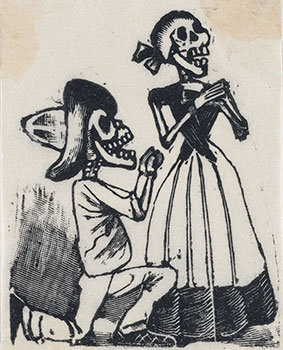
This metal engraving is a vignette for the Feast of the Death, created by Mexican artist José Guadalupe Posada between 1890 and 1910. Image is in the public domain. See larger version of vignette at The Met.
So, what is plot?
Answer: The plot is a series of events that make up a story.
Every story has events that happen in specific orders. And, one event leads us to the next event. Playwrights must consider which events are important to relay to an audience in order to be sure the story they want to tell is told!
Every story is unique to a playwright, but the plot structure, or the tools that a playwright uses to tell the story, is the same.
Plot structure is laid out in Freytag's Pyramid, shown here.
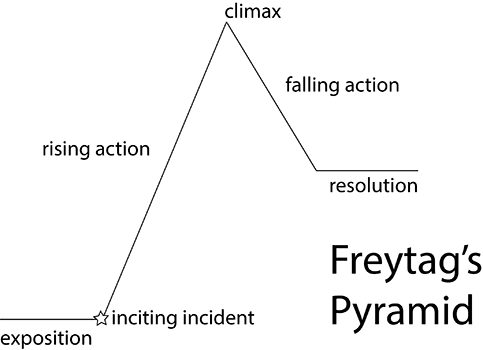
See larger version of Freytag's Pyramid diagram here.
The six components of plot structure are:
- exposition,
- inciting incident,
- rising action,
- climax,
- falling action, and
- resolution.
The exposition is the opening of a play. During the exposition, characters of the play are introduced and any previous knowledge an audience needs to know is shared. This backstory includes relevant events that happened before the play began. For example, does the play begin with a conflict already developing?
Next is the inciting incident, which is the event that directly involves the protagonist in the main story. There may be other events that occur that are setting up the characters and the setting, but this is the event directly related to the main story of the play.
Following the inciting incident is the rising action, or the series of events that relates directly to advancing the main story. These events may complicate the lives of the characters or add suspense to the story. Other events may occur during the play, but the rising action relates directly to the main story being told.
Next comes the climax, the turning point of the story. This is the point of no return! Once this event occurs, there is no stopping the outcome of the play.
Then, you have the series of events that occur after the climax that lead to a conclusion, which is known as the falling action. These events lead us directly to the end of the story. This can be seen as a runaway train; there is no other path that can be taken except the eventual end of the story.
Finally, the play concludes in the resolution, or the end of the story. Any conflicts are settled. This includes the denouement. Do you remember what this is?
Answer: The denouement is the final resolution of the plot.